
विचार / लेख
MINIMUM 80, 2/3RD MAJORITY… MAY TOUCH 100
-Adv. Sudiep Shrivastava
THE RESULT WILL SHIFT FOCUS FROM BSP(Bijli Sadak Pani) to HEEF (Health Education Employment and Farmer)
Punjab is a State where a multi corner contest has happened in which at least three players of different combinations appears to be contesting closely. However at the end it’s the Aam Aadmi Party emerging as clear winner. The Congress despite being in the Government, the Akali Dal – BSP combine could not have impressed upon the majority voters who have referred AAP. Naturally the Amrindar-BJP fails to cut much ice in this contest.
DEMOGRAPHY :
The demography of the State has 32% Dalit Voters most of them are within Sikh Fold who are still struggling to be recognised as powerful voting block as the politics of the State is still under the grip of the Jatt Sikh who are roughly 21% of the total population. The Hindu Upper caste consists of around 12 % whereas other minorities are only about 4%. The Rajput Sikhs are treated as OBC and they are also around 10%. While the other OBCs are 21% of the total population. On religious line Sikhism is the dominant religion with 58% population is following the same whereas 38% follow Hindu Dharm. Another 1.9% Muslim and 1.3% Christian while rest 0.8 % are Jains and Bouddhs.
Following are the main castes of different religions.
Sikhism : Jatt Sikh, Rajput Sikh, Mazahabi Sikh, Ramdasia Sikh
Hinduism-Brahmin, Rajput, Bania, Khatri-Arora-Sood, Sunar, Kamboj, Labana, Tarkhan/Ramgarhia, Kumhar/Prajapati, Arain, Gurjar Teli, Banjara, Lohar, Bhat, Chamar Ad-Dharmi - Balmiki Bhanghi Bazigar
Traditionally the Congress vote bank is in to Jatt Sikh and Dalit voters apart from some Hindu voters post Khalistan movement whereas the BJP-Akali combine counted on the Jatt Sikh and Hindutva preferring Hindus combination. It was only in 2017 the Aam Aadmi Party has made inroads in to the State specially in the Malwa region by winning 18 seats mostly in this region while securing almost 24% of the polled votes. Congress despite loss in vote share by 1.4% and securing just 38.5% of the polled votes won 77 of 117 seats in this triangular fight and Akali-BJP combine could manage just 18 seats with 30.6% votes. BSP despite 32% Dalit population could not win a single seat and ended up with just 2.8% votes.
REGIONS OF THE STATE :
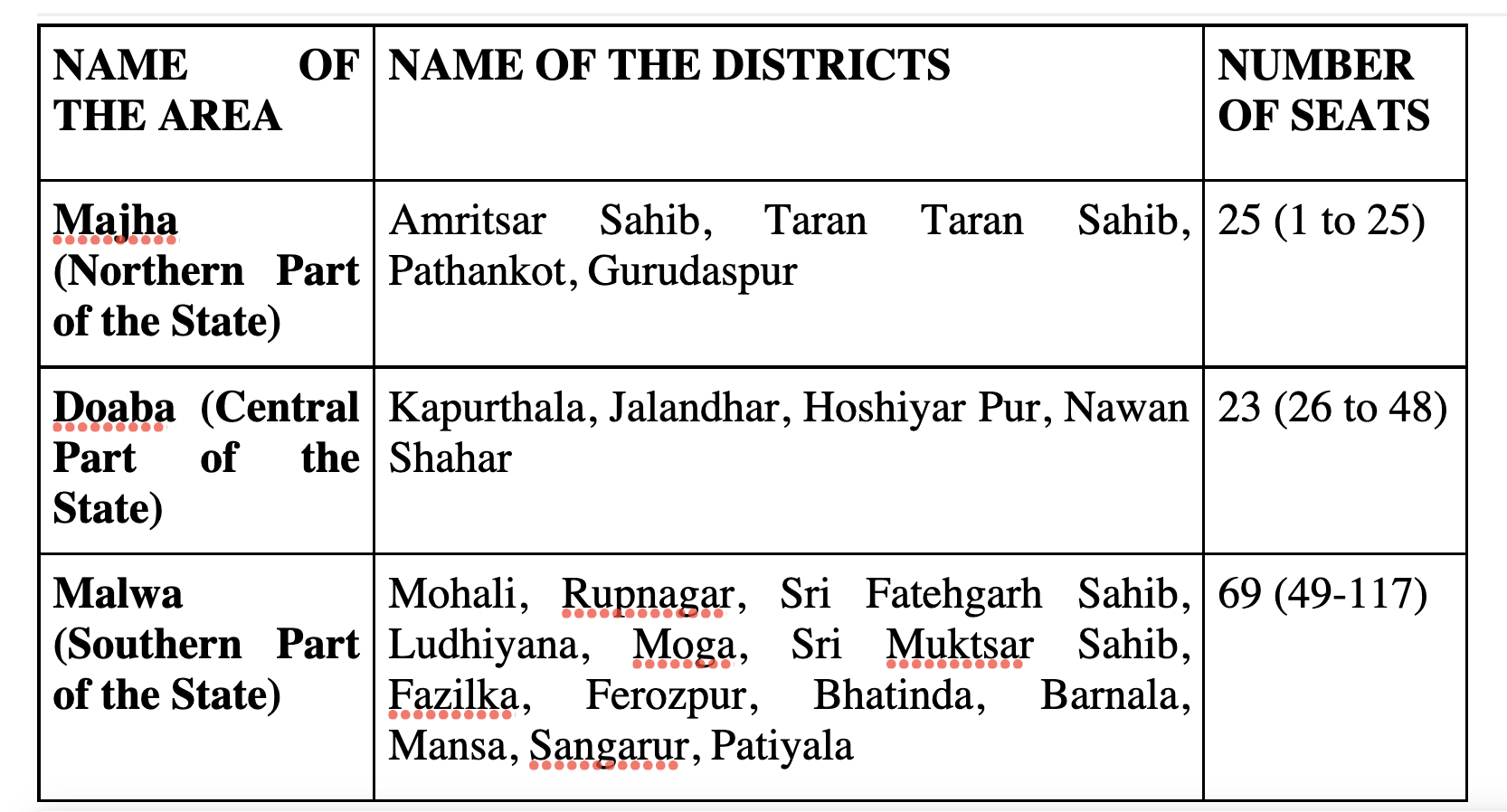
The Punjab is divided into three major geographical regions, Majha, Doaba and Malwa. The Distribution of the districts in to these areas are as follows;
The Amrinder Rule and his ouster :
Captain Amrinder Singh remained the top Congress leader in 2017 and despite High Command’s reluctance, became the Chief Minister. He has promised the voters to deal with, the Drug Menace, Accused of “Be-Adabi of Guru Granth Sahib, Misrule of Badal led Akali Government, with Iron Hands, however he failed to perform on all these counts. The failure to generate employment which is forcing Sikh Youths to migrate abroad only added fuel to this. He was ultimately removed but too later. It did not give enough time to the new incumbent Charanjeet Singh Channi, a Dalit Sikh to mobilise his community en-block for which he was preferred over the challenger Navjot Singh Sidhu. The choice of a Dalit Sikh as CM over traditional Jatt Sikh has not gone down fully well in this short time and it was further fuelled by the periodic outburst of the flamboyant Sidhu.
Akali – BSP combine became irrelevant :
For decades the Punjab politics was hovering between two Political forces i.e. Akali, and Congress. BJP always played second fiddle with Akali while BSP fails to make much impact despite the state having 30% Dalit population. In the Congress Rule of last five years, the Amrinder Government was seen soft towards Badals, and that has led to a belief amongst general voters that both Congress and Akalis are having a tacit understanding between them. This has resulted in continuance of the Anti Incumbency towards Akalis for their 10 year rule between 2007 to 2017. Voters now want to get rid of both the traditional parties and that is why the AAP is getting a decisive mandate.
WHY AAP IS WINNING WITH SUCH A BIG MAJORITY :
There are three main reasons for AAP sweeping the Punjab almost the way it did in Delhi. First reason is AAP was very much a contender in 2017 as well, but because of Amrinder led Congress also being in opposition and very vocal against the Akali Government, voters chose a tried a tested Leader and Party instead of AAP which had shied away from declaring the CM Face, leaving the speculation that Kejriwal himself wants to be CM of the State. The Second reason is that the Congress Government did not acted on the major promises it made with the voters and was seen as saving the Badals, leaving with no other choice for voters but to chose AAP as no one was willing to have Akali’s at the helm again. Third reason is the major infighting in the Congress after appointment of the Charanjeet Singh Channi as CM of the State. The Jatt Sikh dominated State Congress, could not digest the elevation of a Dalit Sikh and Channi got too little time to manage, and win over the dissidents in the party. It is common perception that Amrinder should have been removed at least a year before if he was to be. The Sidhu and Sunil Jakhar’s utterances make the life tough for Channi and made the easy way for AAP which is still enjoying sizeable Dalit support. The BJP and Congress both tried to link AAP with Khalistani but on ground no body was willing to listen such an argument considering the anger they have against Congress and Akalis both.
BSP to HEEF
Big Punjab Win for AAP will prove and establish one thing that except Such States which have more than 30% BPL families, the expectations of voters have changed from BSP (Bijli Sadak Pani) to HEEF (Health Education Employment Farmer). It will also prove that showcasing your good work in another State like the AAP did on Education and Health in Delhi and showcased the same in Punjab can bring voters and supporters.
(Writer is a practicing lawyer in Chhattisgarh High Court, and a familiar face on national television election analysis.)